Tokenization is leaving the pilot stage. On 12 November 2026 the Hong Kong Monetary Authority said that it and the Securities and Futures Commission had hosted around 200 industry practitioners to push Project Ensemble forward, after Ensemble TX began enabling 24/7 interbank settlement of tokenised deposits and the SFC approved round-the-clock secondary trading for tokenised money market funds. In the SFC's words, tokenization “is moving beyond experimentation towards commercialisation.”
For asset issuers, that shift raises a practical question: where do your tokens actually live, and how are the rules enforced once they start moving? That is the job RWA Chain was built to do.
What is RWA Chain?
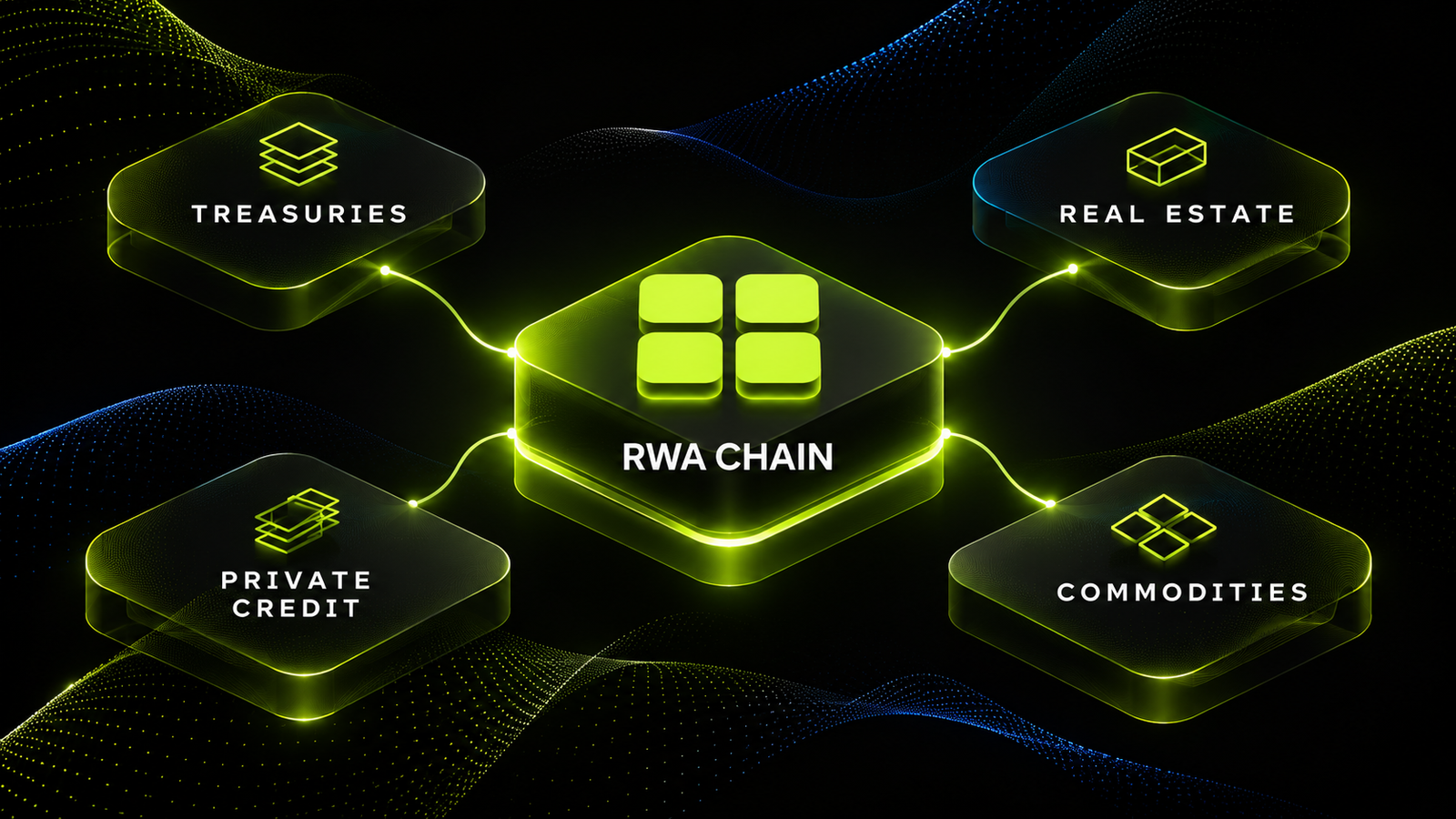
RWA Chain is RWA Inc's settlement layer for real-world assets. It is an Ethereum Layer 2 rollup built on the OP Stack, designed for tokenizing treasuries, real estate, private credit and commodities, with compliance enforced at the protocol level rather than contract by contract.
Put simply, RWA Chain gives issuers a public, EVM-compatible network where the checks a regulated asset needs are part of the chain itself, not an add-on that each project has to rebuild.
The problem RWA Chain solves for issuers
Most blockchains were built for open, permissionless tokens. Real-world assets are different. A bond, a property deed or a fund unit usually comes with rules about who may hold it, where they live and whether they have passed KYC.
On a general-purpose chain, those rules sit in individual smart contracts or in off-chain paperwork. That makes them easy to get wrong and hard for investors to verify. RWA Chain's own description is blunt: “Compliance lives in the protocol, not in a PDF.”
As markets like Hong Kong move to always-on settlement, issuers need infrastructure that can enforce those rules around the clock without manual checks on every trade.
Key features of RWA Chain
Protocol-level compliance with RWA-3643
Assets can be issued as RWA-3643 permissioned tokens. Every transfer runs through identity, eligibility and jurisdiction checks against an on-chain KYC registry before it settles. According to rwa-chain.io, there is no path around that check.
Standards for every asset type
RWA Chain publishes four open asset standards:
- RWA-20: fungible asset tokens, ERC-20 compatible, with transfer restrictions and supply attestations.
- RWA-721: unique deeds for property, art and equipment, carrying legal metadata.
- RWA-3643: identity-bound security tokens with on-chain KYC and jurisdiction rules.
- RWA-4626: tokenized vaults that distribute coupon and rental income on-chain.
A defined issuance process
Issuance follows a set sequence: legal wrapper verified, custody attested, supply matched to the off-chain register, then the token is minted. Today, linking each token to its real asset is done by the issuer's attestation; an oracle network to automate this is on the roadmap.
Low fees, familiar tools
RWA Chain is EVM-equivalent, so Solidity contracts, Foundry scripts and standard EVM tooling work out of the box. The site describes sub-cent fees, and users can pay gas in $RWAINC through a forwarder instead of holding ETH. That makes small, frequent actions like coupon payments and redemptions practical.
Security, stated plainly
Fault proofs let anyone challenge a result, and the token contracts are deliberately not upgradeable, so an issuer cannot quietly rewrite the rules on someone else's asset. RWA Chain is also open about what is not built yet: the protocol contracts are pending independent audit, there is no bug bounty programme, and custody integrations and attestation oracles are still on the roadmap.
Who RWA Chain is for
- Asset issuers and fund managers who want to bring debt, credit, real estate, commodities or fund interests on-chain with eligibility rules built in.
- Real-world financing businesses, from trade finance and receivables to equipment and infrastructure projects.
- Developers and fintech teams building issuance tools, compliance services or secondary markets on an EVM network.
If you are an investor rather than an issuer, you may find Tokenized Stocks on stocks.rwa.inc or the Launch platform a better starting point.
How to get started with RWA Chain
- Explore the network. Visit rwa-chain.io to read the asset standards and open the explorer.
- Test for free. Use the testnet at testnet.rwa-chain.io (chain 77410 on Base Sepolia), which offers free test ETH, a faucet and a bridge.
- Connect your tools. Add RWA Chain to your EVM tooling (chain ID 7741, RPC https://rpc.rwa-chain.io) and deploy with Foundry, Hardhat, viem or ethers.
- Tokenize an asset. Issuers can start through RWA Inc's company intake or the Tokenization Platform to scope their asset.
- Talk to the team. Email partner@rwa.inc with questions about your use case.
RWA Chain FAQ
What is RWA Chain used for?
RWA Chain is used to issue and settle tokenized real-world assets such as treasuries, real estate, private credit and commodities. It is an OP Stack Layer 2 where compliance checks run on every transfer.
How does RWA Chain keep tokenized assets compliant?
Assets issued as RWA-3643 tokens are tied to verified identities. A transfer only settles after both sender and receiver pass identity, eligibility and jurisdiction checks against the on-chain KYC registry.
Can I test RWA Chain before going live?
Yes. RWA Chain runs a free public testnet on Base Sepolia with a faucet and bridge, so teams can deploy and test contracts using the tools they already use.
Bring your assets on-chain with RWA Chain
Tokenization is moving from experiments to real markets. If you issue or manage real-world assets, RWA Chain gives you a compliant, low-cost, EVM-compatible home for them. Explore RWA Chain and start building at rwa-chain.
Want to see more of the ecosystem? You can also build an app in plain language with Enter or redeem a gift card on the Claim Portal.